

Earlier this week, the Securities and Exchange Commission (SEC) released its enforcement results for Fiscal Year 2026 (FY26 Enforcement Results). The FY26 Enforcement Results show a continued reduction in proceedings commenced and recoveries obtained. These outcomes align to a degree with the SEC’s back-to-basics approach that focuses on holding individuals accountable and prioritizing harms to retail investors. As usual, the SEC also highlighted specific developments—reorganizational efforts and case filings and outcomes—that reflect this approach to current priorities.
Key Takeaways
- The SEC initiated fewer enforcement actions in Fiscal Year 2026 (FY26) than in Fiscal Year 2025 (FY25) and Fiscal Year 2024 (FY24).
- Total SEC recoveries, disgorgement, and civil penalties in FY26 were down from FY25 and FY24.
- Funds returned to investors and payouts to whistleblowers were both up from FY25 to FY26.
- The Division of Enforcement (Division) underwent organizational changes intended to enhance its ability to pursue SEC enforcement priorities.
- These priorities, reflected in the cases that the Division discussed, include traditional areas of enforcement, holding individuals accountable, and addressing harm to retail investors.
Enforcement Activity by the Numbers
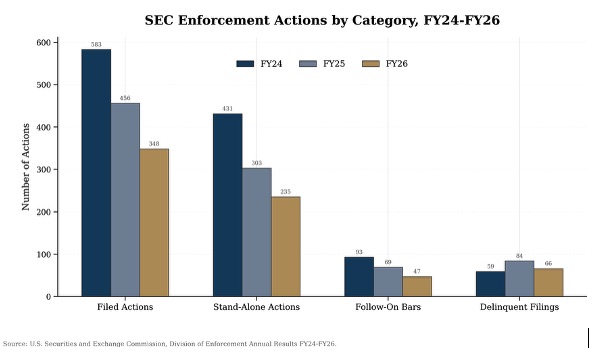
At a high level, the FY26 Enforcement Results show the SEC filing 348 enforcement actions. Of these, 235 were stand-alone actions, 47 were follow-on administrative proceedings to bar or suspend participation in securities market activities, and 66 were related to delinquent filings. The FY26 Enforcement Results also highlight 13 trading suspensions in connection with suspected manipulation of Asia-based issuers’ securities.
Relative to prior years, the FY26 Enforcement Results reflect a continued reduction in filed enforcement actions.
- Filed enforcement actions in FY26 decreased almost 24% from FY25, which, itself, was approximately 22% lower than FY24. (FY24 filed enforcement actions were, themselves, down approximately 26% from Fiscal Year 2023 (FY23).)
- Of the 348 filed enforcement actions in FY26, 45 (or almost 13%) arose from a single Form ADV investigation. The SEC filed 38 of these cases on a single day in late August.
- The only primary classification in the SEC reporting that is up from FY25 is insider trading—39 total proceedings in FY26 versus 32 in FY25.
- The SEC brought no Foreign Corrupt Practices Act cases in FY26.
- The SEC appears to have not sought a single asset freeze or temporary restraining order in FY26.
- Stand-alone actions experienced similar rates of decline—approximately 23% from FY25 to FY26, 30% from FY24 to FY25, and 14% from FY23 to FY24.
- Two-thirds of stand-alone actions named at least one individual as a defendant.
- Follow-on suspension or bar actions experienced similar decreases—approximately 32% from FY25 to FY26 and 25% from FY24 to FY25.
- Although actions involving delinquent filers experienced an uptick from FY24 to FY25, the cases are down approximately 21% from FY25 to FY26.
- Many delinquent-filer actions appear to be against “zombie companies.” One involved a company that had not filed since 2001.
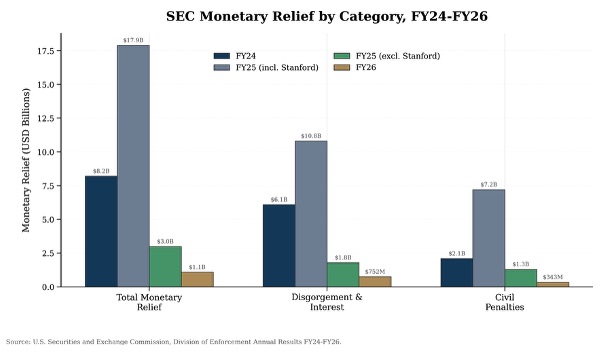
Like actions filed, monetary recoveries are down from FY25 to FY26. The amount of monetary relief achieved in FY26 is also down from FY25. (Monetary amounts were rounded to tenths. For more precise detail, please see the underlying SEC data.
- Total monetary relief is down nearly 94% from FY25 to FY26. In FY25, the SEC obtained $14.9 billion in monetary relief from the long-running Stanford International Bank (Stanford) case, which skews FY25 data. Even removing that, total monetary relief is down approximately 64% from FY25. Although total monetary relief was up from FY24 to FY25, removing Stanford would reverse that gain into negative territory.
- Disgorgement is down approximately 94% from FY25 to FY26. Even with removing the $9 billion in disgorgement associated with Stanford, disgorgement is down approximately 58%. Although total disgorgement increased from FY24 to FY25, that increase reverts to a negative if Stanford disgorgement is removed.
- Civil penalties are down approximately 95% from FY25 to FY26. Even with removing the $5.9 billion in civil penalties associated with Stanford in FY25, civil penalties are down approximately 74%. The increase in civil penalties from FY24 to FY25 reverts to a negative if Stanford is removed.
- The total FY26 civil penalties of $343 million is a near-20-year low.
- A single firm paid 29% of these civil penalties.
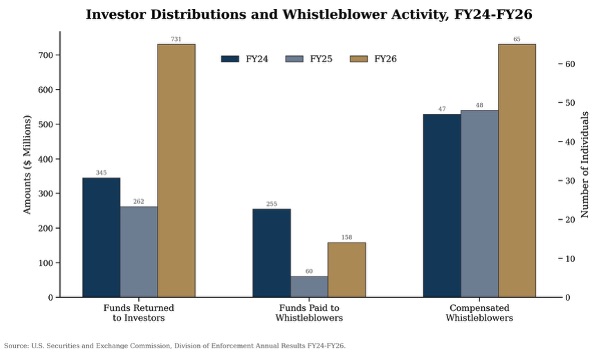
As recoveries declined, distributions to investors and whistleblowers both climbed significantly.
- In FY26, the SEC returned $731 million to harmed investors, about 2.8 times the amount returned in FY25.
- Although these distributions certainly involve funds collected in prior fiscal years, they are a metric of enforcement efficacy that reflects the SEC’s prioritization of investor protection.
- Funds paid to whistleblowers are up by a substantial percentage—nearly the rate of increase in funds returned to investors.
- The number of individual whistleblowers who received compensation in FY26 increased by a substantial percentage from FY25—approximately 35%. The total number of individual whistleblowers was largely unchanged from FY24 to FY25.
- Although total compensated whistleblowers increased, this is not a record number of them.
Restructuring to Align with Enforcement Priorities
During FY26, the SEC implemented a range of restructuring efforts within the Division to “modernize its organization and processes to increase its investigative and litigation capacity, address evolving market risks, and deliver more timely, impactful outcomes.”
- Retail Fraud Working Group. The Division formed its Retail Fraud Working Group (RFWG) to identify misconduct—such as Ponzi schemes, offering frauds, impersonation scams, and market manipulation—that poses risk to “everyday investors.” The RFWG has been using data-driven strategies and cross-agency collaboration. The FY26 Enforcement Results reports that the RFWG initiated more than a dozen investigations.
- Financial Reporting and Accounting Unit. The Division formed its Financial Reporting and Accounting Unit (FRAU) to expand its capacity to address complex accounting financial reporting and other related misconduct. The FRAU combines experienced lawyers and accountants to enhance the ability to detect misconduct and to promote consistent enforcement recommendations.
- Office of Super Intelligence and Analytics. The Division formed the Office of Super Intelligence and Analytics to bring data analytics and artificial intelligence more centrally into investigative workflows. The Division identified anomaly detection, document and transcript review, and blockchain and financial-flow analysis as workflows currently using these tools.
- Trial Unit Reorganization. The Division reorganized the Trial Unit by adding Deputy Chief Litigation Counsels. These attorneys will oversee trial counsel throughout all offices, rather than having regional trial counsel supervised by regional office leadership.
- Updated Enforcement Manual. For the first time since 2017, the Division updated the Enforcement Manual. The Division highlighted (i) updates to the Wells process to increase “transparency, consistency, and clarity,” (ii) simultaneous consideration of settlement recommendations and related waiver request, and (iii) the explanation of the framework for evaluating cooperation.
- Recission of Rule 202.5(e). The SEC rescinded the no-deny policy in Rule 202.5(e), allowing a settling party to publicly deny the SEC allegations. Previously, the SEC conditioned all settlements on a commitment to not deny SEC allegations.
Highlighted Enforcement Actions Signal Priorities
The Division identified noteworthy enforcement actions. These enforcement actions signal the SEC’s current priorities.
- Cross-Board Fraud. The Division identified a number of enforcement actions demonstrating the focus on cross-border enforcement. These actions include charging 45 entities, including a number from overseas, in three jurisdictions with filing false Form ADVs to feign legitimacy and lure retail investors; charging purported crypto trading platforms, investment clubs, and other entities apparently operated from overseas with running confidence scams to defraud retail investors; and instituting 13 trading suspensions arising from suspected manipulation of Asia-based issuers’ securities.
- Retail Investor Harm. The Division summarized cases involving Ponzi schemes, affinity fraud, and other fraudulent conduct against retail investors. The Division called out additional cases involving the pre-IPO market, where retail investors were lured to make investments based on profitable pre-IPO positions and then were defrauded through various means.
- Investor-Protection Guardrails. The Division identified actions designed to “reinforce critical investor-protection guardrails, which strengthen compliance by holding marking participants accountable for failing to meet their obligations.” These guardrails include the Custody Rule, Regulation Best Interest, privacy and identity protection, suspicious activity reporting obligations, Bank Secrecy Act obligations, and blue sheet compliance.
- Market Integrity. The Division highlighted cases involving market manipulation and insider trading, including spoofing, deceptive trading, and misuse of material nonpublic information by employees, gatekeepers, and other professionals. The Division characterized this work as part of “its return to basics.”
- Accurate Disclosure, Accounting, and Financial Reporting. The Division called out ten filed, adjudicated, or settled actions involving (i) companies and executives for disclosure, accounting, and financial reporting fraud and (ii) auditors and an audit firm for failure to comply with accounting and auditing standards.
- Investment Advisers and Private Funds. The Division pursued actions involving misappropriated client funds, inadequate safeguarding, disclosure deficiencies, fraudulent valuations, and undisclosed conflicts by investment advisers.
In addition to the above substantive areas of enforcement attention, the Division reiterated three areas of focus. First, the Division noted a commitment to holding individuals accountable. The Division noted that two-thirds of its initiated actions in FY26 involved charges against an individual. Second, the Division emphasized the importance of prompt remediation and meaningful cooperation in investigations to mitigate charging and penalty decisions. The Division discussed three settled matters where the SEC imposed no civil penalty because of cooperation and remediation. On the other end of the spectrum, the Division identified two cases involving significant penalties where the entities were aware of the misconduct and failed to remediate it. Third, the Division reported on whistleblower efforts. As discussed above, the whistleblower program, an integral part of the Division’s enforcement tools, was active in FY26. The staff received approximately 26,000 whistleblower tips, and the SEC paid $158 million to 65 individual whistleblowers.
About the Authors
David E. Carney, Cory Kirchert, Adriaen Morse, B. Jonathan Haskin, and Katherine N. Zeda are attorneys at SECIL Law PLLC, a boutique investigations and litigation firm representing corporations, executives, boards of directors, and individuals in securities enforcement, white-collar defense, government and internal investigations, regulatory matters, and complex civil litigation.
Together, they advise clients on high-stakes SEC enforcement actions, securities regulatory compliance, internal investigations, and complex matters involving the U.S. Securities and Exchange Commission, the U.S. Department of Justice, and other enforcement authorities. They can be reached at dcarney@secillaw.com, ckirchert@secillaw.com, amorse@secillaw.com, jhaskin@secillaw.com, and kzeda@secillaw.com, respectively.